The 7 Construction Site Inspection Checklists Every UK Site Manager Needs (And How to Go Digital)
Discover the 7 essential construction site inspection checklists for UK compliance. Learn how digital checklists eliminate paperwork and reduce audit risk.
Site inspections are the backbone of construction safety and quality in the UK. Whether you are checking scaffolding before the morning shift, reviewing fire safety provisions, or conducting a weekly CDM walkthrough, the inspection checklist is your proof that due diligence was done.
But here is the problem: most site managers are working from photocopied templates, loose sheets stuffed into folders, or — worst case — doing inspections from memory and writing them up later. When the HSE asks for your inspection records, that approach falls apart fast.
This guide covers the seven essential construction site inspection checklists every UK site manager should be running, and explains how switching to a digital inspection checklist app can save you hours while keeping you audit-ready.
Why Checklists Matter More Than You Think
Inspection checklists are not bureaucracy for the sake of it. Under the Construction (Design and Management) Regulations 2015, principal contractors must plan, manage, and monitor health and safety throughout the construction phase. Regular inspections — with documented evidence — are a core part of meeting this duty.
When something goes wrong on site, the first question from the HSE, insurers, or solicitors is: what inspections were carried out, and where is the evidence? A completed checklist with dates, signatures, photos, and corrective actions is your strongest defence.
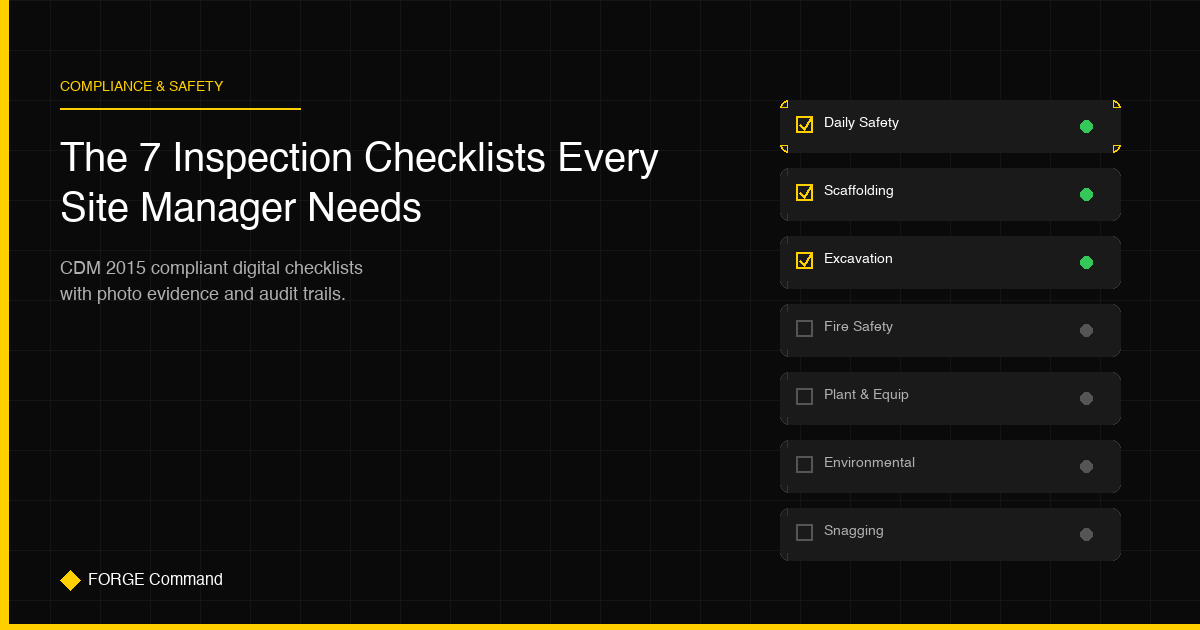
The 7 Essential Inspection Checklists
1. Daily Site Safety Walkthrough
This is your bread-and-butter inspection. Before work starts each day, walk the site checking:
- Access routes and egress points clear
- Welfare facilities operational (toilets, drying rooms, drinking water)
- First aid provisions in place
- PPE compliance across all operatives
- Housekeeping — materials stored safely, walkways clear
- Temporary works and barriers secure
This should take 20-30 minutes and catches 80 percent of issues before they become incidents.
2. Scaffolding Inspection
Under the Work at Height Regulations 2005, scaffolding must be inspected before first use, after any event that could affect stability (storms, impacts), and at intervals not exceeding 7 days. Your checklist should cover:
- Base plates and sole boards correctly positioned
- Standards plumb and ledgers level
- Bracing adequate and secure
- Guardrails, toeboards, and brick guards in place
- Access ladders tied and in good condition
- Loading within design capacity
- Scaffold tag signed and current
3. Excavation Inspection
Excavations over 1.2 metres deep require formal inspection under CDM 2015. Check:
- Shoring and trench support adequate
- Barriers and edge protection around open excavations
- Ground conditions stable — no water ingress or soil movement
- Underground services marked and avoided
- Spoil heaps at safe distance from the edge
- Safe means of entry and exit
4. Fire Safety Inspection
Under the Regulatory Reform (Fire Safety) Order 2005, construction sites need fire safety management. Weekly checks should include:
- Fire extinguishers in place and serviced
- Fire escape routes clear and signed
- Hot works permit system in operation
- Flammable material storage compliant
- Temporary heating equipment safe and maintained
- Fire alarm or warning system functional
5. Plant and Equipment Inspection
PUWER and LOLER require that all work equipment is maintained and inspected. Cover:
- Daily pre-use checks completed by operators
- LOLER certificates current for all lifting equipment
- Electrical equipment PAT tested
- Guards and safety devices operational
- Defective equipment tagged out of service
6. Environmental and Waste Inspection
Environmental compliance is increasingly enforced. Monthly checks should cover:
- Waste segregation and duty of care compliance
- Dust suppression measures operational
- Silt and pollution prevention in place
- Noise mitigation consistent with Section 61 consent
- Hazardous materials stored and labelled correctly
7. Pre-Handover / Snagging Inspection
Before practical completion, a thorough snagging inspection protects your reputation and avoids costly callbacks:
- All works completed to specification
- Surface finishes acceptable
- Mechanical and electrical systems tested and commissioned
- Building control sign-offs obtained
- Health and safety file documentation compiled
- Clean and safe for occupant handover
The Problem with Paper Checklists
Paper checklists work in theory. In practice, they suffer from the same issues as paper site diaries:
- They get lost. A completed inspection form left in the site office has a limited shelf life before it disappears into a filing cabinet — or a skip.
- No photo evidence. Writing “guardrail missing on level 3” is less convincing than a timestamped photograph.
- No corrective action tracking. Paper cannot send a notification to your foreman that the issue needs fixing by tomorrow.
- Slow reporting. When the client asks for this month inspection summary, paper means hours of collation.
Going Digital: What Changes
A digital inspection checklist app transforms every aspect of the process:
- Consistency: Every inspector follows the same template, every time. No missed fields, no blank sections.
- Photo attachments: Snap a photo of the issue and it is embedded in the checklist entry with a timestamp and GPS location.
- Instant corrective actions: Flag an issue, assign it, set a deadline. The responsible person gets notified immediately.
- Automatic audit trail: Every completed checklist is stored with date, time, location, and the inspector identity. This cannot be backdated or tampered with.
- One-tap exports: Generate a professional PDF report for any date range and send it to whoever needs it.
How FORGE Command Handles Inspections
FORGE Command includes a dedicated audit and inspection module built specifically for UK construction requirements. You can run any of the seven checklists above from your phone, attach photos, flag issues for corrective action, and export completed inspections as PDF reports.
The app works offline — critical when you are inspecting basements, plant rooms, or any area with no signal. Entries sync automatically when you reconnect.
All of this comes included in the one-time £39.99 purchase. No monthly inspection fees. No per-checklist charges. No per-user subscriptions.
Getting Started
You do not need to overhaul your entire inspection process on day one. Start with the daily site safety walkthrough — it is the one you do most often and where time savings are most noticeable. Once your team is comfortable with digital inspections, add scaffolding, excavation, and fire safety checklists.
Within a week, you will wonder how you ever managed with paper.
Ready to digitise your site management?
FORGE Command gives you everything covered in this article, and more, in one powerful mobile app. Digital site diaries, audit checklists, UK regulation search, AI email templates and role-based dashboards.
Get FORGE Command — £39.99 One-time purchase • No subscriptions • 30-day guarantee